Persistent Memory Is Not Persistent Execution State
Persistent memory is not persistent execution state. Memory is the durable autobiography — transcripts, embeddings, summaries, profile files — the record of what happened; execution state is the live tuple of process tree, memory pages, file descriptors, sockets, and PTY, the what is happening on a real machine right now. They are orthogonal axes with different primitives, lifespans, and failure modes: an agent can have a flawless memory and still reason against a server that was reaped the instant its client disconnected. The execution-state continuity layer is the missing piece that keeps that live runtime alive as a single-homed, ownerless object — so “is the server still running?” has an authoritative answer that does not depend on what the agent remembers doing.
Your agent remembers the conversation. It is sure the dev server is still running on port 3000. It isn’t — the process was reaped when the client disconnected.
This sentence contains the single most expensive misunderstanding in contemporary AI-agent design. The agent will happily tell you it started the server. It logged the command. It summarized the step into its working notes. It may even have written “dev server running on :3000” into a memory.md file that will faithfully survive for months. And every word of that record is true about what the agent did. None of it is true about what is currently happening on the machine. The launcher returned exit code 0, the process was reaped when the client disconnected, and the agent is now reasoning confidently against an environment that no longer exists.
The industry has spent two years building extraordinary machinery to make agents remember. Vector databases, hierarchical summarization, episodic and semantic memory layers, profile files, retrieval pipelines. This work is real and valuable. But it has quietly produced a category error so pervasive that most teams cannot see it: the conflation of memory persistence with execution-state persistence. These are not two grades of the same thing. They are different objects, with different primitives, different lifespans, and — most importantly — different failure modes. This article is about the boundary between them, and it draws the first of the distinctions that define the missing architectural layer for AI-native computing: execution-state persistence is not memory persistence.
Two different objects
Start with precise definitions, because the whole confusion lives in loose language.
Execution state is the live tuple of what is running right now on a real machine:
S_e(t) = ( P_cpu , M_pages , F_fd , N_sock , T_pty )P_cpu— the processor execution context: program counter, registers, the position of every running process in the process tree.M_pages— the virtual memory pages: heap, stack, mapped libraries of every live process.F_fd— the open file-descriptor table: active offsets, locks, pipes, the handle the half-finished migration holds on the database.N_sock— the network sockets: the open connection to Postgres, the bound listener on :3000, the in-flight TCP state.T_pty— the pseudo-terminal configuration: the interactive shell, the scrollback buffer, the line discipline that knows a password prompt is currently blocking on stdin.
Execution state is what is happening. It exists only while the processes exist. It is, by default, annihilated the instant the process tree dies or the client that spawned it disconnects.
Memory state is something else entirely — the durable record of what happened:
- message arrays and conversation transcripts,
- embeddings and vector indexes,
- rolling summaries and compacted context,
- profile and rules files (
user.md,memory.md, persona specs).
Memory state is text and vectors. It serializes cleanly to disk, replicates trivially, and is engineered to outlive any single session. It is the agent’s autobiography.
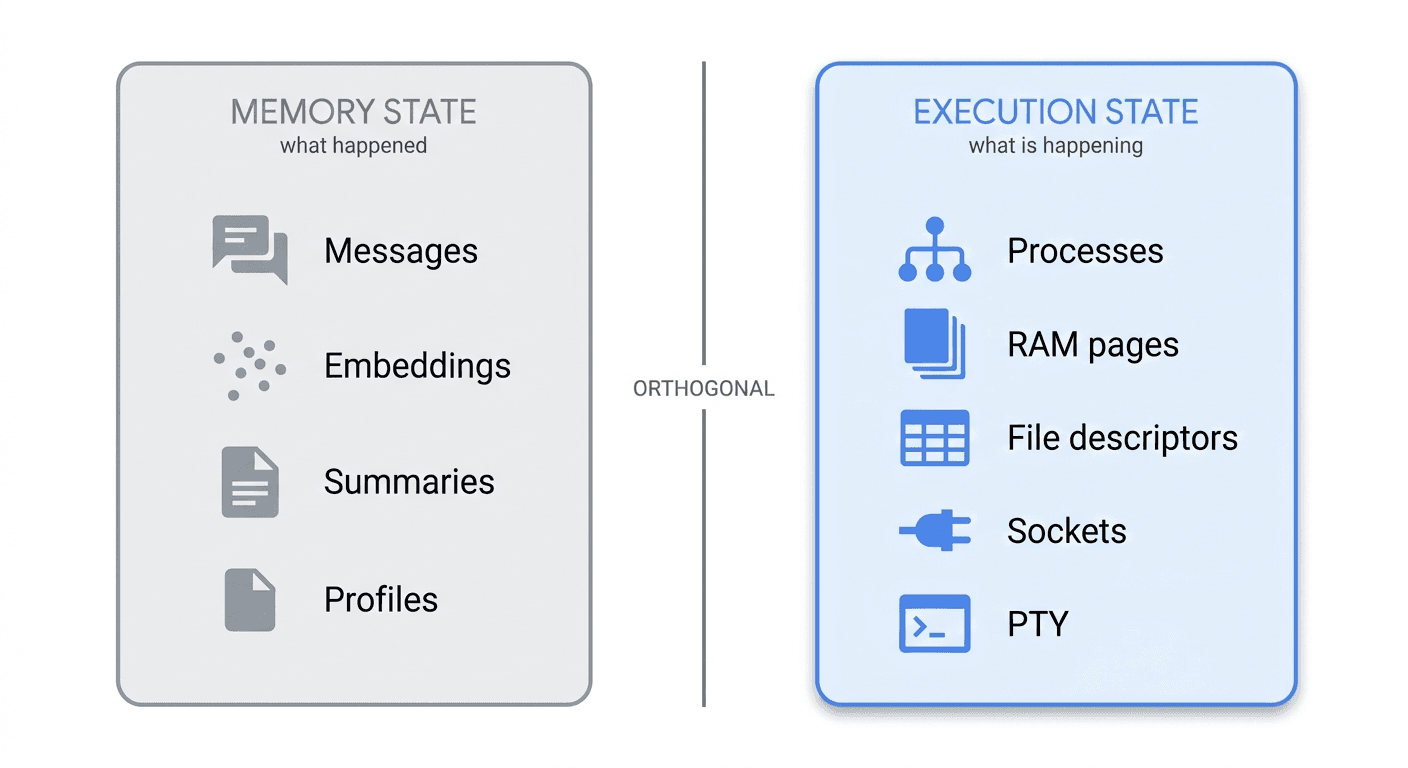
The error is treating a perfect autobiography as if it were a pulse. Here is the contrast laid out by primitive:
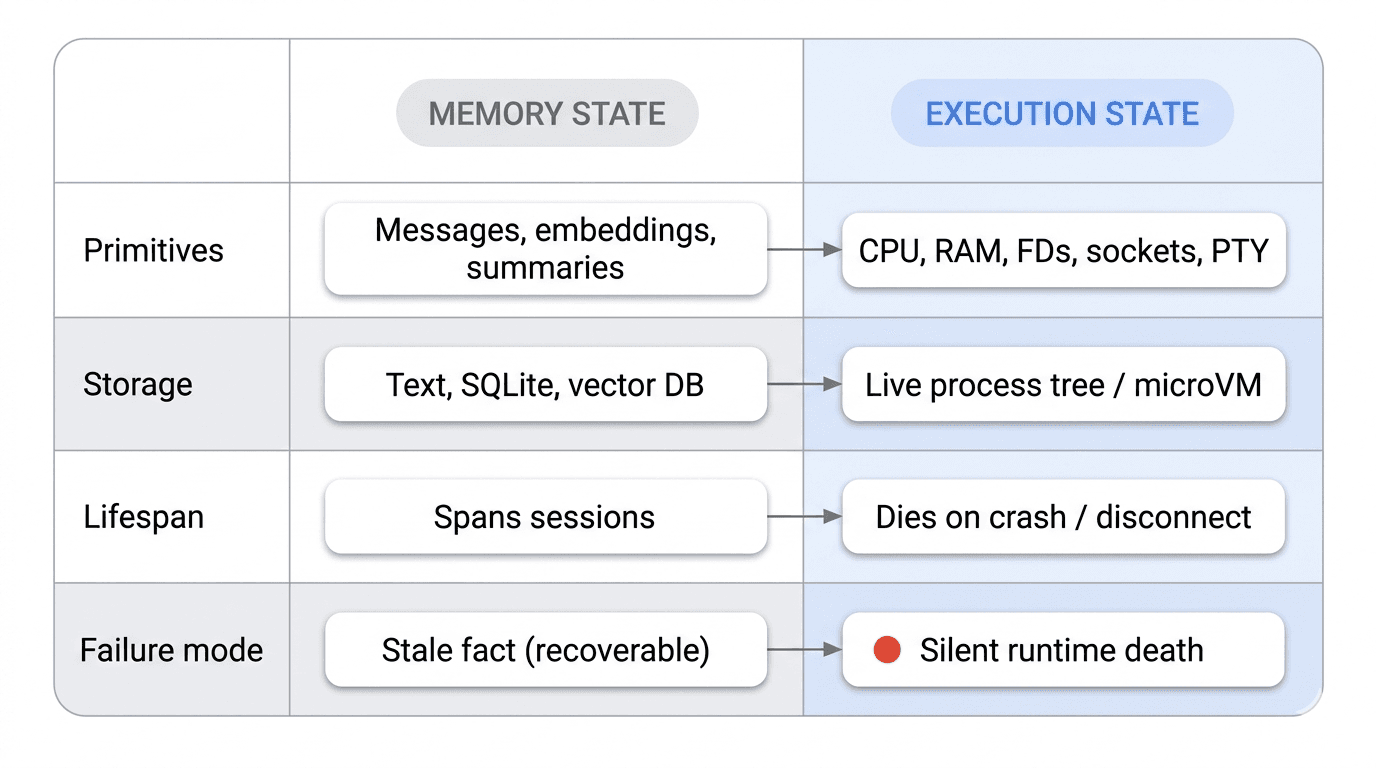
A system can be perfect on the left column and have nothing on the right. That is the default state of almost every agent framework shipping today.
Failure modes only execution-state persistence solves
If memory persistence were enough, this would be a vocabulary quibble. It is not, because there is a class of failures that no amount of memory can prevent. They are failures of alignment between the agent’s model of the world and the live machine.
Silent background-process death. The agent runs npm run dev &, the launcher returns 0, and the agent records success. The client session ends ten minutes later; the orphaned process is reaped with it. The agent’s next turn issues curl localhost:3000 and gets connection-refused — and now must spend LLM calls diagnosing a failure that is not a bug in the code but an artifact of its own missing runtime continuity. Memory remembers the intent to run a server. Only execution state can tell you a server is listening on a socket right now.
Interactive blocked states the agent cannot see. A command hits an authentication challenge, an apt configuration screen, a sudo password prompt. The process is alive but blocked on stdin, waiting on a PTY line discipline the agent’s stateless command wrapper does not own. With no persistent terminal, the agent sees a hang, not a prompt. It cannot distinguish “working hard” from “waiting for input it will never receive.” A persistent execution-state primitive can observe the PTY block pattern and route an input — from the model or a human — into the live stdin stream.
Non-deterministic re-execution after a crash. When the runtime is ephemeral and only memory survives, recovery means redoing. The agent re-runs the migration that was half-applied, re-installs the dependency, re-issues the API call. Without a persistent execution graph of what physically completed, “resume” collapses into “restart,” and restart against a partially-mutated environment is how you get duplicate writes and corrupted state.
Hallucinated environment alignment. This is the deepest one. The model builds its entire picture of the system from text returned by stateless calls. It assumes a process is alive because a launcher exited cleanly. Its internal narrative — reinforced by a flawless memory of having started everything — diverges silently from P_cpu, the real process tree. The agent is not lying. It is sincerely describing a machine that no longer matches reality, because it was never connected to the live state in the first place.
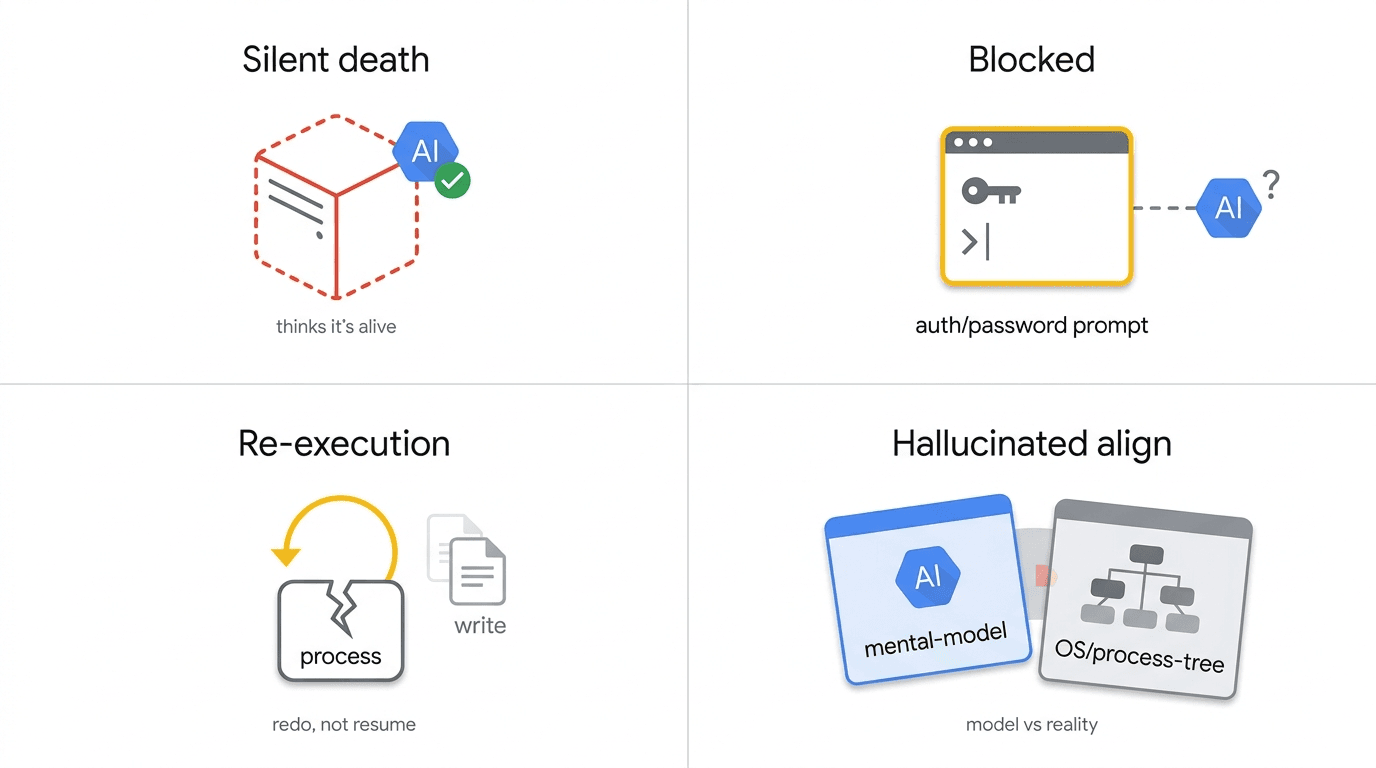
Notice the common thread: every one of these is invisible to memory by construction. Memory is a record of decisions; these are failures of the substrate the decisions ran on.
The heap that outlived its UI
One node from the long lineage of the live session makes the memory-versus-execution distinction unusually crisp, so take just that one. (Part 1 walks the full arc — screen, tmux, tmate, Guacamole, cloud workspaces, Live Share, agent runtimes; here only one brick is load-bearing.)
The Jupyter kernel decoupled a live heap from the UI that displays it. An independent kernel process holds your variable tables, imports, and open connections in memory, while notebook clients disconnect and reconnect over ZeroMQ without losing the computation. This is the precise shape of the distinction this article is about: the notebook cells — the saved code and markdown on disk — are memory state, the autobiography of what you typed; the kernel’s resident heap is execution state, what is running right now. You can reopen a saved notebook on any machine and read every cell (memory persisted perfectly) and still find that df is undefined because the kernel that held it died (execution state gone). Jupyter solved continuity for the heap — but bound it to one kernel process, and only for interactive notebooks. It is the closest the field came, early, to treating the live runtime as separable from its client; it stopped one slice short of treating the execution state itself as a first-class object.
The agent era inherited that gap and made it worse — because agents added a magnificent memory layer on top while leaving the runtime as disposable as ever.
Where current systems sit
Map the landscape against the two columns and the pattern is stark.
Memory-rich, execution-state-poor systems dominate the agent-framework category. Architectures organized around conversational memory — the Hermes-class design, and most LangChain- or AutoGen-style loops — invest heavily in the left column: SQLite with full-text search across past sessions, layered SOUL/USER/MEMORY context files, retrieval over episodic and semantic stores. Their execution backends, by contrast, are pluggable and disposable: dispatch a payload to a fresh container or serverless worker, collect the text output, discard the process. Process lineage is decoupled, the heap is unrestorable, there is no native PTY representation in the core. They have a flawless autobiography and no pulse between turns.
Contrast that with systems whose center of gravity is a live persistent workspace. Container-backed development sandboxes that route every command through a persistent shell and keep an interpreter kernel resident across turns (the OpenHands-style action-execution server is a clear public example) hold the runtime open so that a cd, an environment variable, an installed package, or a loaded variable survives from one action to the next — and a human can attach to the same live filesystem and terminal mid-task. microVM snapshot engines (E2B) push further on the durability of the live environment itself, capturing filesystem, memory, and processes in a whole-guest snapshot. Workspace platforms (Daytona, Gitpod) persist the disk volume across stops but clear volatile memory on stop — durable environment, not durable live process. These systems are doing real execution-state work, to differing depths. The frontier question — the subject of the rest of this series — is whether that live state is treated as a first-class, addressable, transport-independent object or as an implementation detail bolted under a particular client.
The point here is narrower and it is the category edge: memory persistence and execution-state persistence are orthogonal axes. A system can be world-class on one and absent on the other. Most are. Almost every other confusion in agent architecture is downstream of missing this.
Why it matters now
For a single-turn assistant, none of this bites. You ask, it runs one command, it answers; if the runtime evaporates afterward, who cares. The gap was tolerable precisely because agents were short.
They are not short anymore. Long-horizon agents now run for hours and execute hundreds of tool calls — software-engineering runs, multi-stage migrations, deep research loops, overnight build-and-test pipelines. Across that horizon the two curves diverge catastrophically. The memory curve grows steadily and serves its purpose: the agent accumulates context, summarizes, retrieves. Meanwhile the execution is rebuilt from scratch over and over — a server started and silently lost, a connection opened and dropped, a migration begun and re-begun, an environment assumed-alive and quietly dead. The longer the task, the more the agent’s rich, growing memory describes a runtime that was repeatedly demolished underneath it.
The economics make it sharp. LLM calls are slow and expensive. An agent that crashes at step nine of ten and can only redo, not resume, is not merely inconvenient — it burns the budget and risks compounding corruption on every retry. The response is visible in the systems that hold a runtime open across turns — the resident-kernel pattern, where an interpreter process keeps the heap alive between actions instead of rebuilding it each time. That is the same Jupyter shape again, now load-bearing under agents: keep the live state, not just the record of it. (Part 1 lays out the full convergence across runtimes; here only the resident kernel is needed to make the memory-versus-execution point.)
Naming the layer
What is being rebuilt, over and over, by every team that hits the long-horizon wall is the execution-state continuity layer — the layer that keeps the live tuple (P_cpu, M_pages, F_fd, N_sock, T_pty) alive and observable independent of any client, so that “is the server still running?” has an authoritative answer that does not depend on what the agent remembers doing.
Memory and execution state are both worth persisting. But they are different objects and they fail in different ways, and a memory layer — however sophisticated — will never tell you whether the compiler is still running. Memory remembers what happened. Execution state is what is happening. Build for one and you have an agent with a perfect autobiography and amnesia about the machine in front of it.
cmdop (cmdop.com ) is one reference implementation that treats execution state as a first-class persistent object on exactly these terms — the live runtime kept continuous and addressable beneath whichever client, human or agent, attaches to it. The broader point stands regardless of implementation: until the field separates the autobiography from the pulse, agents will keep remembering servers that are no longer there.
See it in the product: how cmdop keeps the two separated — Memory (the autobiography) versus the execution-state object (the live pulse).
 Cmdop
Cmdop